|
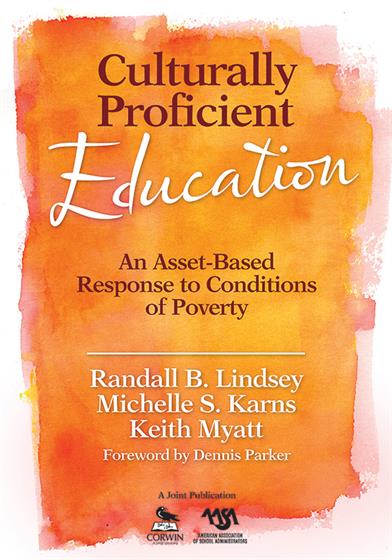
Randall B. Lindsey | California State University Los Angeles |
| Michelle S. Karns | Consultant | |
| Keith Myatt | California State University, Dominguez Hills |
Foreword by Dennis Parker
| © 2010 | 176 pages | 7" x 10" |
A Joint Publication With the American Association of School Administrators
| Paperback | ISBN: | 9781412970860 | $31.95 | Add to Cart |
| Ebook | ISBN: | 9781452210100 |
|
|
| Complimentary Review Copy | Request Review Copy | |||
"This new application for cultural proficiency is a testament to the educator-student relationship based on respect, understanding, and a common purpose, no matter what the background or culture of the student happens to be. We can't afford for more students to disengage from education. Thankfully, the authors provide a framework that builds on where we are and that moves us toward a positive, asset-building environment rather than a destructive deficit mind-set."
—Kathleen Gavin, Coordinator of Professional Development
Great Prairie Area Education Agency, Burlington, IA
Develop culturally proficient policies and practices that create opportunities for students of poverty!
Written to counter the perspective that students from low-income backgrounds come to school with certain deficits that prevent them from learning, this timely resource provides educators with the knowledge and skills to maximize educational opportunities for all students, independent of students' socioeconomic status.
The authors examine equity and social issues through the lens of cultural proficiency, an approach that emphasizes how educators can break down self-imposed barriers to student success through self-reflection, personal change, and organizational reform. Focusing on students' strengths, this guide provides:
Culturally Proficient Education helps teachers and school leaders clear the path to success for students of all social and economic backgrounds.
|
Randall B. Lindsey | California State University Los Angeles |
| Michelle S. Karns | Consultant | |
| Keith Myatt | California State University, Dominguez Hills |
Foreword by Dennis Parker
| © 2010 | 176 pages | 7" x 10" |
A Joint Publication With the American Association of School Administrators
| ISBN: 9781412970860 | Paperback | Suggested Retail Price: $31.95 | Bookstore Price: $25.56 |
| ISBN: 9781452210100 | Electronic Version | Suggested Retail Price: $31.95 | Bookstore Price: $25.56 |
"This new application for cultural proficiency is a testament to the educator-student relationship based on respect, understanding, and a common purpose, no matter what the background or culture of the student happens to be. We can't afford for more students to disengage from education. Thankfully, the authors provide a framework that builds on where we are and that moves us toward a positive, asset-building environment rather than a destructive deficit mind-set."
—Kathleen Gavin, Coordinator of Professional Development
Great Prairie Area Education Agency, Burlington, IA
Develop culturally proficient policies and practices that create opportunities for students of poverty!
Written to counter the perspective that students from low-income backgrounds come to school with certain deficits that prevent them from learning, this timely resource provides educators with the knowledge and skills to maximize educational opportunities for all students, independent of students' socioeconomic status.
The authors examine equity and social issues through the lens of cultural proficiency, an approach that emphasizes how educators can break down self-imposed barriers to student success through self-reflection, personal change, and organizational reform. Focusing on students' strengths, this guide provides:
Culturally Proficient Education helps teachers and school leaders clear the path to success for students of all social and economic backgrounds.
Should you need additional information or have questions regarding the HEOA information provided for this title, including what is new to this edition, please email corwinheoa@corwin.com. Please include your name, contact information, and the name of the title for which you would like more information. For information on the HEOA, please go to http://ed.gov/policy/highered/leg/hea08/index.html.
We hope you'll consider this Corwin book for your course. Email us at adopt@corwin.com, or click here to find your Corwin Sales Manager.
Corwin
2455 Teller Road
Thousand Oaks, CA 91320
www.corwin.com